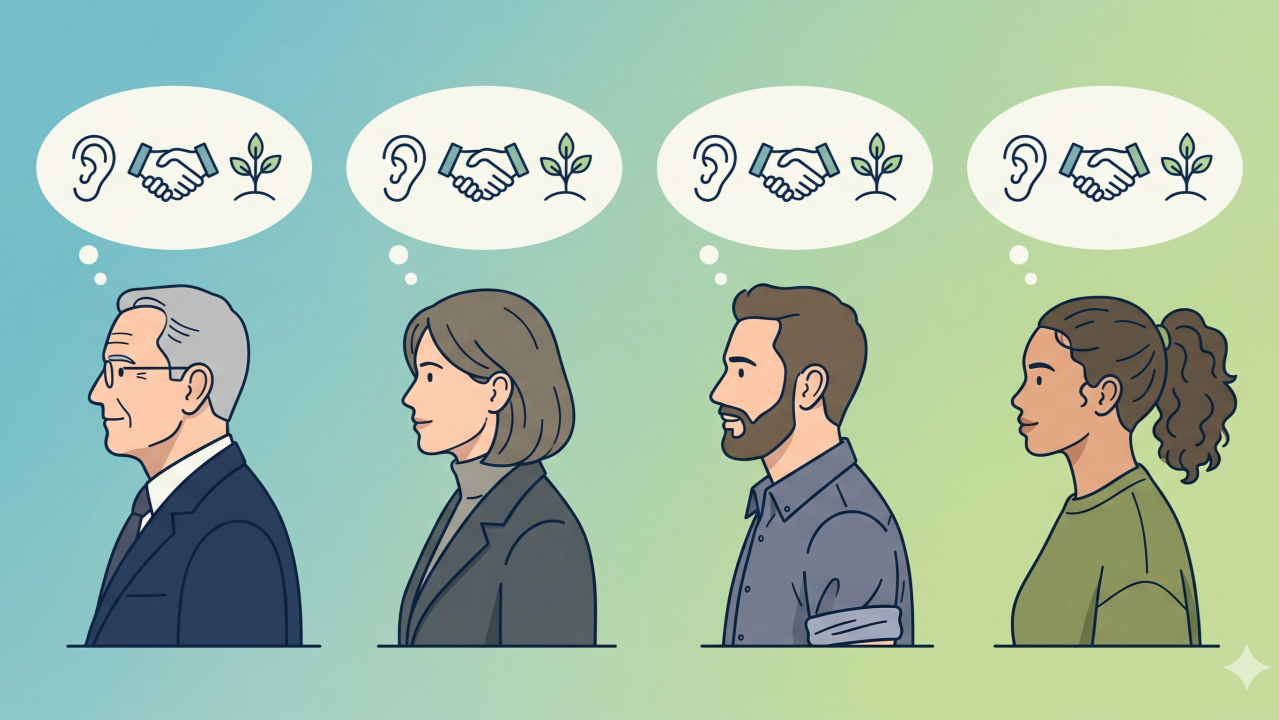
I've been delivering the same talk on intergenerational leadership for an executive development program since 2019. Since then I've had three children and a lot has changed. In the early editions we mostly talked about Millennials. Now GenZ has taken the spotlight. The trending topics keep rotating.
But there is one thing that doesn't change.
When I ask the leaders in the room to think about their ideal leader and tell me what that person did for them, the answer is almost always the same. It doesn't matter if they are Boomers, GenX, Millennials or GenZ. Their ideal leader listened to them. Showed real interest. Trusted them. Helped them grow. Protected them. Met them at their level of development and gave them what they needed at that moment.
This repeats edition after edition. And while I listen to today's answer, the same one I heard in 2019, I keep thinking the same thing: if we all want pretty much the same thing from a leader, why do we keep talking about the generational gap as if we were different species?
What keeps that narrative alive, at least from what I see in my practice, is something I would call generational self-centeredness. We assume we are being empathetic with another generation because we treat them the way we would like to be treated, or the way it worked well for us to be treated. It sounds good. But it is still projecting. What worked for us is not necessarily transferable to the others.
An example I often see. A manager tells me: I give them exposure, I bring them with me to every meeting, I give them access to everything. In their eyes, that is helping them grow. And many times, without realising it, what they are giving is exposure without any sense attached to it. For that younger person, being in the meeting without knowing why, without a clear expectation, without being asked for anything concrete, is an empty experience.
The small piece that moves this is not complicated. It is telling them: come, take note of whatever feels relevant to you, and we'll talk afterwards. What do you think? What's your feedback? What would you do differently? When you guide them with questions adjusted to their level, the same meeting stops being presence and becomes participation with sense.
There is another part I often see. These generations arrive immersed in the digital world, with a pandemic behind them and a lot of social, family and technological change. Sometimes they find it hard to share how they are or what they think. And the leader, who receives nothing, assumes disinterest. But the silence of someone with less experience is not disinterest. Often what is missing is for the more experienced leader to model it first: share their own opinions, their expectations, how they feel. And only then, over time, start asking about it.
Less is more. Short, frequent, focused interactions. They tend to be far more effective than an agenda of exposure without a script.
And if I leave today thinking one thing, it is this: the circle will keep repeating itself unless someone does something different. That responsibility, in my view, belongs to the one with more experience and more background. Not to the one who is just arriving.
When was the last time you actually asked the younger person near you what they need from you, instead of giving them what you would have liked to receive?
Did this resonate?
If this connects with something you're working on, let's talk.
30 minutes by video call. No commitment. You'll know if I can help and, if I can't, I'll tell you who can.
Book a conversation →