I've been turning a question over in my head for a while now — one that almost no leader asks out loud, but that quietly shapes more of their calendar than they'd care to admit: if I let go, who am I?
It never shows up phrased like that, of course. It shows up dressed in sensible reasoning. "This project is too delicate." "I'd rather review it myself." "I can do it faster." "Once the team is a bit more seasoned, I'll hand it over." Each sentence, on its own, holds up. It's hard to argue with any of them. But when you sit with the person and look at the whole picture from a step back, something else starts to take shape.
What I've seen surface, again and again, is an identity tied to being at the centre.
For many of the directors I've worked with, their sense of professional worth has been built, over years, on the same foundation: being the one who holds it together, the one who knows, the one who shows up when there's a problem. It's worked for them. It's probably part of how they got where they are. And then someone — often from HR, or someone like me in a coaching process — suggests they delegate more, let go, make space. They nod. They get it intellectually. And nothing happens.
Nothing happens, I think, because what's being asked of them isn't tactical. They're being asked to pull apart two things that have been fused for a long time: what they do and who they are.
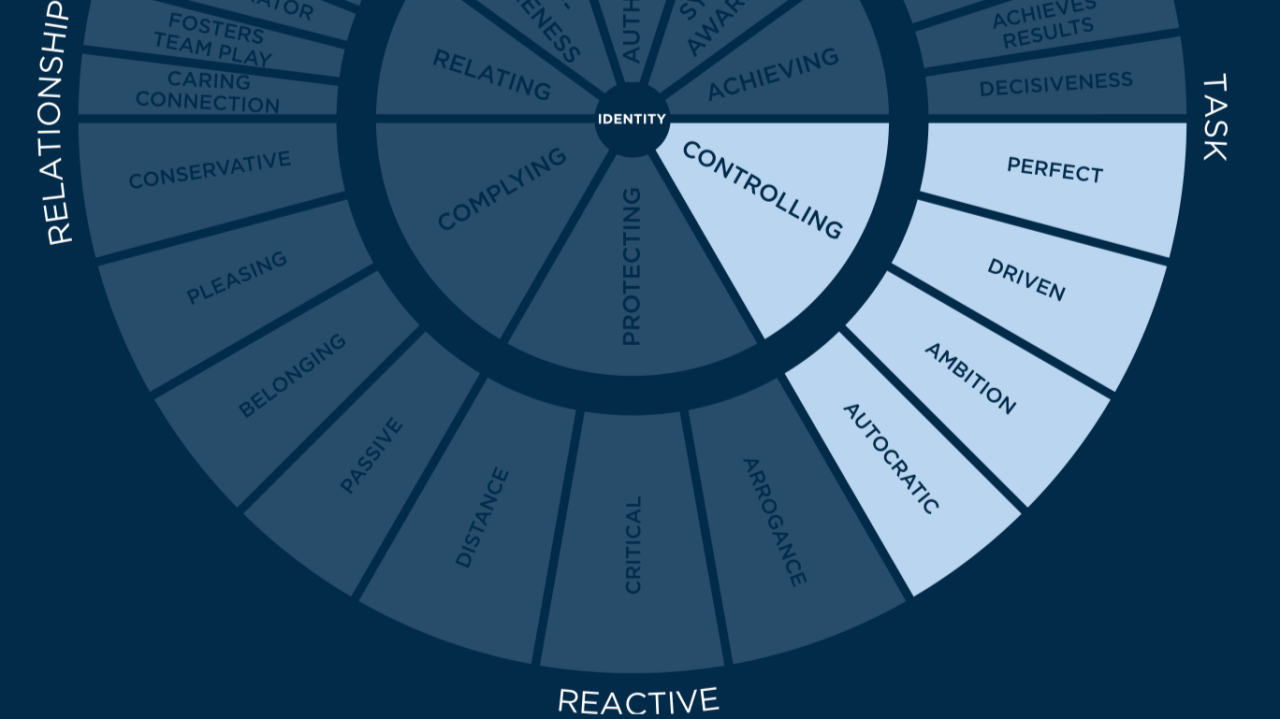
In Leadership Circle, the model I work with most often, this pattern tends to show up at the intersection of three dimensions: Controlling, Driven and Perfectionist. And the interesting thing is that it's not really one of them carrying the weight, it's the three reinforcing each other. The need for control provides safety. The drive provides identity. Perfectionism offers a reasonable excuse never to fully let go. It's a closed system and, it has to be said, a fairly effective one for keeping yourself afloat. With one catch: it leaves no room for growth — not for the person, not for the team.
That's why, when someone comes into a session saying "I need to delegate more," I try not to go in through that door. I go in underneath. There's a prior conversation almost no one wants to have before talking about what to let go of: if you stopped being the one who holds it all together, where would your sense of professional worth come from?
That question doesn't get answered in one session. Sometimes it takes months. And until there's a real answer to it — their own, not borrowed — any delegation plan is just paper.
For those of you who support leaders from HR, this has a practical implication. When a high-performing executive resists letting go, the issue is rarely about time. It's not about trust in the team. It's not about tools. It's about identity. And that doesn't get solved by a delegation workshop, however well designed.
A question to leave you with:
What part of who you are professionally depends, right now, on staying indispensable?
Did this resonate?
If this connects with something you're working on, let's talk.
30 minutes by video call. No commitment. You'll know if I can help and, if I can't, I'll tell you who can.
Book a conversation →