In today's dynamic corporate environment, understanding and navigating the complex web of influences within an organization is fundamental to the success of any project.
Contrary to the conventional notion that decisions are made strictly within the confines of an organizational hierarchy, the reality is far more nuanced. In any organization, there are multiple centers of power and influence that transcend traditional hierarchical levels. These include not only individuals in positions of authority, but also those who exercise influence in more indirect or subtle ways.
Influence can emanate from personal relationships, networks of trust, and experts both inside and outside the organization. Recognizing this web of influences is the first step toward effectively directing efforts toward achieving common goals, anticipating resistance, and optimizing resource allocation.
The Influence Map
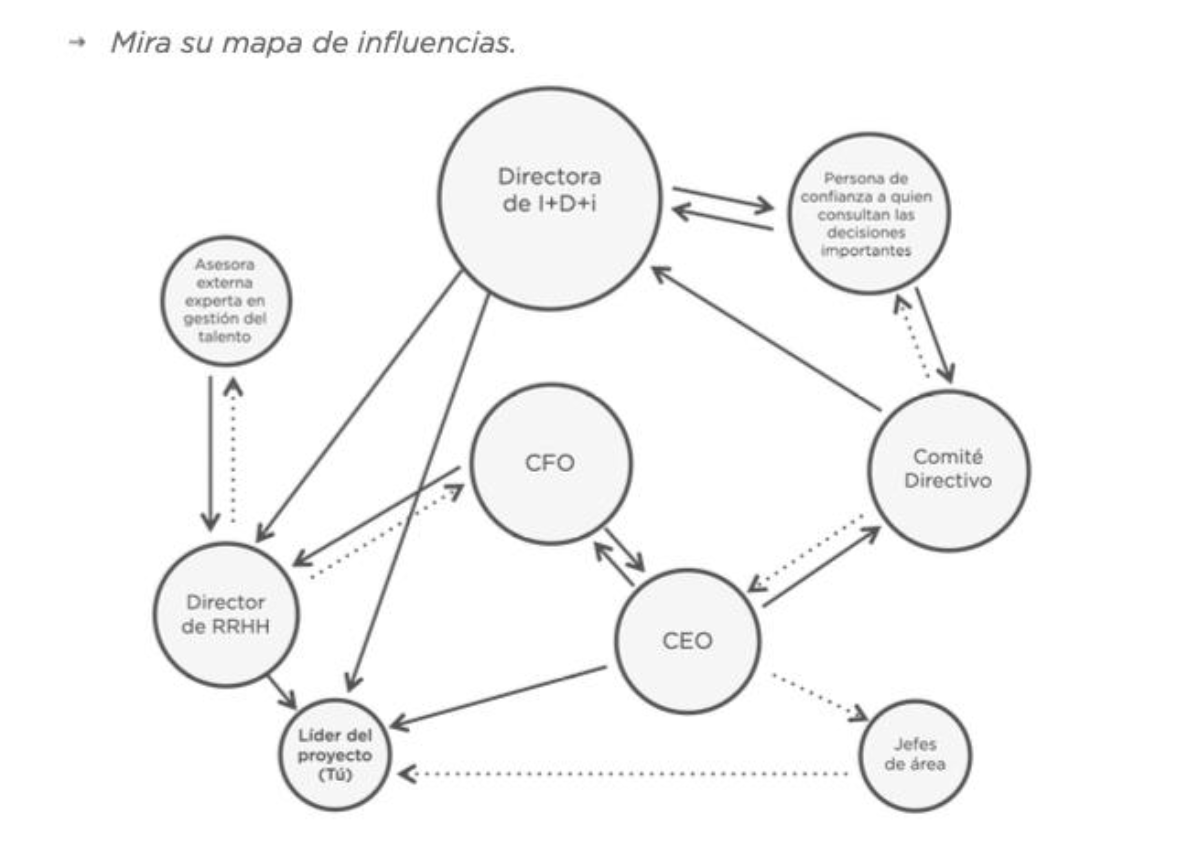
The Influence Map emerges as a valuable tool in this context, allowing us to visualize the weight and dynamics of relationships between the different actors who impact a project or idea. This map highlights not only the magnitude of each person or group's influence, represented by the size of their circle, but also the nature of their relationships, indicated by arrows and the style of lines (solid or dotted). Such visualization facilitates the identification of potential allies, adversaries, and the key relationships that need to be cultivated or strengthened.
Practical Case
Let's consider the case of a new project aimed at fostering innovation through collaboration between junior and senior members of the organization. When analyzing the influence map, we observe that the director of innovation possesses significant influence, not only over other areas, but even over the CEO. Additionally, an external figure is identified with a crucial role in key decisions. This analysis reveals not only the sources of formal and informal power, but also how these influences can be channeled to support the initiative.
Source: El líder Inusual
Strategies to Maximize Influence
A detailed understanding of the influence map allows us to develop strategies aimed at maximizing a project's impact.
This includes:
- Strengthening key relationships: Identifying and cultivating relationships with key individuals who can act as champions for the project.
- Managing resistance: Anticipating and developing action plans to handle possible resistance from those less aligned with the project's objectives.
- Leveraging external influences: Recognizing and utilizing the influence of external advisors or subject matter experts to validate and promote the initiative.
Conclusions and Recommendations
Navigating the complex landscape of influences within an organization is essential for the success of any initiative. The effective use of the influence map provides a solid foundation for understanding and acting upon existing power dynamics. For leaders, adopting this tool means not only driving projects more effectively, but also fostering a more collaborative and innovation-oriented work environment.
Exercise: Creating Your Own Influence Map
- Objective: Develop a practical understanding of how internal and external influences affect decision-making in your organization and how to use this information to drive your projects.
Instructions
- Identifying key actors: List the people or groups within and outside your organization that you consider to have influence over important projects or decisions. Include both individuals (e.g., CEO, director of innovation) and groups (e.g., innovation department, external advisors).
- Assessing the weight of their influence: For each person or group identified, assess the weight of their influence on a scale from 1 to 10, where 10 indicates the most significant influence over important decisions.
- Based on this assessment, draw circles proportional in size to each actor's level of influence on paper or design software. The most influential actors should have the largest circles.
- Relationship Analysis: Draw arrows between the circles to represent
- The influence relationships between the different actors. The direction of the arrow indicates who influences whom.
- Use solid lines to represent strong and direct influence relationships, and dotted lines for weaker or indirect relationships. Reflection and Strategy
- Analyze the map you've created and reflect on the following questions:
- Who are the most influential actors in your organization and why?
- Are there unexpected or less evident influences that could be key to the success of your projects?
- How can you strengthen relationships with key actors to secure their support or minimize resistance?
- Based on your analysis, develop a brief strategy on how you could use this map to promote a new project or idea within your organization.
Did this resonate?
If this connects with something you're working on, let's talk.
30 minutes by video call. No commitment. You'll know if I can help and, if I can't, I'll tell you who can.
Book a conversation →